

A few weeks ago the World Health Organisation reiterated its (unpopular) finding that no screen time is recommended at all before the age of one, and from 12 months to two years, at most one hour of screen time per day with a firm ‘less is better’ condition attached.
As usual, the responses from overwhelmed and exhausted parents – and some educators – was one of snide dismissal. The thought of zero screen time wasn’t just unrealistic, it was probably unhealthy! It was ‘technophobic’. Screens exist. Are they really suggesting that we should pretend, for ideally two whole years, that they don’t?
Is a ruling like this ever that cut and dried?
As we work alongside families we may find ourselves conflicted. What is done, what is believed and what is ‘known’ can sit uncomfortably with what science shows us, as professionals, to be ‘right’. One of my core beliefs – despite it never making it to my official philosophy – is that we have to learn to pick our battles. Is this one worth fighting?
Critical years
Dana Suskind, director of the Thirty Million Words Initiative, works with families to teach parents to effectively communicate with their children during the critical years of brain development.
Suskind explains, “The screen of a human being saying exactly the same thing as somebody face to face will have absolutely no effect on the language learning (because) it’s not responsively contingent”.
What this means, essentially, is that it’s not a conversation. What is going to be said was predetermined, and there’s no back and forth between the child and the speaker.
At 24 months, children who have been exposed to less language are slower processors. As a result, they can’t pick up newer words… you’re not just behind in the race of life, you’re a slower runner, and that’s why you don’t catch up.
Dana Suskind, Thirty Million Words
Responsive contingency
Interestingly though, studies show that when this responsive contingency is offered between adults and children, such as in a Skype chat with grandma, the presence of the screen is essentially irrelevant. Screen time becomes an issue when it replaces those social interactions and conversations that are fundamental for building neural pathways from birth.
Earlier this year, researchers from Ohio State University found that children who by the age of five were given frequent opportunities for responsive contingency via shared reading could have heard an average of 1.4 million more words than children who were not read to.
Language development has a compounding effect. Because you don’t need to think so much about words you know, you can keep building new words. We recognise this as the ‘language explosion’ which occurs between the ages of one and three.
With many experts believing that the critical period for language development ends as early as five years old, you can imagine how much more challenging or even impossible it may be for a child to catch up at school if they hear, and therefore have, fewer words than their peers.
TV is no substitute
TV is no substitute for responsive communication.
Again according to Suskind, “At 24 months, children who have been exposed to less language are slower processors. As a result, they can’t pick up newer words… you’re not just behind in the race of life, you’re a slower runner, and that’s why you don’t catch up”.
That’s pretty dire. So how do we apply this understanding, reasonably and rationally, as we work with children and their families? How do we advocate for every child’s right to environments rich in these responsively contingent language experiences without telling families that using screens for an occasional reprieve makes them negligent?
Passive and active screens
In my extended family we love Skype to keep in touch. At home, we also love using the laptop side by side to look up ‘how it’s made’ videos and learn together. We love watching music clips and choreographing (generally terrible) dance routines together
Simply put; we should be able to get by without television, which is so low on the responsive communication scale.
But I have something to confess.
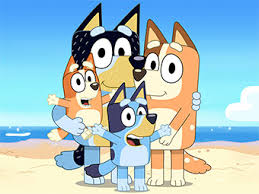
I. Love. Bluey.
More specifically, I love Bandit; the part-time working, quick-witted, super-attentive dad-bodded patriarch of the Heeler family in the ABC TV show Bluey.
I would argue that what makes Bluey so wonderful is the nuanced way it draws on quintessential elements of the Australian parenting experience and tells us we’re not alone. Bandit’s not perfect, but he’s the perfect blend of attentive and sassy, sarcastic and sincere, and ironically – he doesn’t need the tv.
One night, after the kids went to bed, I asked my husband to watch it with me. He laughed his way through it, then shook his head and smiling, said “This is us!”.
In a way; he was right; but not us all the time. The Heeler family are us on a great day. Us after a good night’s sleep. Us when we don’t have work deadlines making us cranky, or an unspoken stalemate over undone dishes dragging well into its second day… they’re the parents we want to be.
Confronted by knowledge
Sometimes research can be confronting. It can highlight the ways that we fall short, and it can be very easy to take it personally; as parents or as teachers.
Sometimes, we have to make the active decision to recognise how new understandings, uncomfortable or inconvenient they may be, provide us with an opportunity to advocate for improved outcomes for children.
So, I’m an educator and a mum, and my kids watch Bluey on the non-responsive television screen.
I’m not perfect, and I don’t think it’s my role as an educator to demand that parents try to be. If we work alongside families we can balance screen time as part of a diverse ‘technology diet’.
We can help families to understand why the guidelines for best practice exist. We can highlight all the things that families are doing right. And we can encourage them to see why we make the choices that we make in our classrooms.
Maybe when we feel conflicted by new ideas it’s not about choosing to battle or not. Rather, armed with the results of research, we can help identify the ‘enemy’ and demonstrate possible battle strategies to our war-weary parenting soldiers.
